


Introduction to our Internship Programme
Welcome to our Internship Programme!
A unique opportunity designed to provide you with a hands-on, immersive experience that bridges the gap between academic learning and real-world application.
Whether you’re aiming to develop specialised skills, gain industry insights, or kickstart your professional journey, this programme is tailored to nurture your potential and help you excel.
Our internships offer a supportive and dynamic environment where you will work on meaningful projects, collaborate with seasoned professionals, and receive mentorship to guide your growth. You’ll have the chance to contribute to impactful initiatives while enhancing your skills and knowledge in your chosen field.
PROGRAMME OUTCOMES

Practical Skill Development
Gain hands-on experience in your field, applying theoretical knowledge to real-world scenarios. You’ll leave the programme with enhanced technical and soft skills, such as problem-solving, communication, and project management

Industry Insight
Understand the inner workings of the industry, including its trends, challenges, and opportunities. This experience will help you make informed decisions about your career path and future aspirations

Network Building
Establish connections with professionals in your field, opening doors to potential future opportunities and collaborations

Portfolio Enhancement
Build a portfolio of work that showcases your contributions and achievements during the programme. This tangible evidence of your capabilities will be invaluable in future job applications

Increased Confidence
Develop a sense of confidence in your abilities as you overcome challenges, meet deadlines, and contribute to the success of a team or project

Career Readiness
Gain clarity on your career goals and direction, equipped with the knowledge and experience to pursue them effectively
We are excited to support your growth and success during this internship. Together, we’ll make this experience a stepping stone toward achieving your professional aspirations
Thank you for your interest in our internship programme.
Please note that applications for this Summer closed on Fri 13th March 2026 for a July start of a 12-week programme.
The next window to apply will be Feb 2027.


From Fragmented Spend to £10m Saved: Rebuilding Procurement From the Ground Up
Outcomes
The engagement delivered £8 million in in-year cash savings against an original target of £13.5 million — with an exit run rate of £10 million per annum, providing a sustainable platform for ongoing benefit. A new procurement and supply chain operating model was fully installed and operational by the end of the programme, with all benefits fully traceable within business unit P&Ls — giving the organisation the transparency and accountability it had previously lacked.
Background
Despite the scale of its procurement spend, the business had no single, consolidated picture of what it was buying, from whom, or at what cost relative to the external market. Spend data was fragmented across business units, making it impossible to leverage the collective purchasing power of the organisation or to hold performance to account against any meaningful benchmark.
Previous procurement improvement efforts had already been factored into business unit budgets — meaning the bar for this engagement was set not at delivering savings in principle, but at delivering hard cash in the current financial year. The stretch target was unambiguous, and there was little room for the kind of multi-year programme that procurement transformations typically require.
Curzon Approach
Curzon began by creating a definitive spend cube — consolidating fragmented data into a single, authoritative picture of procurement spend across the business. This was the essential foundation: without it, there was no way to identify where the real opportunities lay or to build a credible case for action.
With a single set of numbers agreed, we conducted both a top-down and bottom-up analysis of spend at the detailed category and supplier level — identifying impactable spend and prioritising opportunities by size, speed, and deliverability. A structured implementation plan was developed and executed, with benefits closely monitored and recorded as they were realised to ensure traceability directly into business unit P&Ls.
In parallel, Curzon redesigned the procurement and supply chain organisation — bringing in the necessary skills and expertise to ensure the new operating model was not only installed but capable of sustaining the gains independently. The focus throughout was on in-year delivery: every workstream was sequenced and resourced to ensure that savings were cash-realisable within the financial year, not deferred to future periods.
CASE STUDIES
Read some of the client problems we have solved!







Rationalising a Six-Site Footprint Into a Self-Funding, Customer-Ready Operation
Outcomes
The recommended footprint optimisation was accepted in full, a self-funding capital investment with a two-year payback period. The new operations and supply chain configuration met customers’ requirements for in-country sourcing, directly protecting and enabling future contract growth. Implementation was designed to minimise disruption through a people-centred approach, reducing HR-related risk and ensuring the retention of critical capabilities. Crucially, key stakeholders across all principal sites were engaged and aligned throughout, giving the new model genuine organisational ownership from day one.
Background
The business had grown organically over time, accumulating a complex web of intra-company and external supply chain relationships spread across multiple sites. The result was slow production cycle times, an unwieldy planning process, and a cost base that made it difficult to price competitively for either retention or new business.
The absence of a clear make-or-buy policy meant that costly in-house production was being maintained in areas where external sourcing would have been both cheaper and more flexible. And with customers beginning to impose requirements for in-country sourcing, the existing multi-continent footprint risked becoming not just inefficient, but a barrier to winning future contracts altogether.
Curzon Approach
Curzon applied a structured, fact-based diagnostic across the full breadth of the business — examining product, people, customers, regulation, operations, and supply chain through the Curzon framework. This comprehensive view of the organisation provided the solid foundation needed to develop a credible set of options rather than defaulting to an obvious but potentially suboptimal solution.
From the diagnostic, we developed an options-based operating model to serve as an anchor point for scenario evaluation across three primary lenses. Rather than presenting a recommendation and seeking sign-off, we worked interactively with key stakeholders from across the business — testing the practical feasibility of each scenario and building the ownership that would be essential for successful implementation.
Priority options were then subject to extensive assessment, including a detailed financial evaluation conducted in close cooperation with the client’s finance function, to identify the configuration that best balanced profitability with the ability to capture future market opportunities. The resulting recommendation was not only financially robust — it was structured to be self-funding, with a clear two-year payback that removed the need for external capital commitment.
CASE STUDIES
Read some of the client problems we have solved!

Excess Mortality Report
The Silent Toll: Highlighting the Surge in Non-Covid Excess Mortality Amongst the Young and Exploring Potential Causes
The Pandemic is now a memory, yet non-Covid deaths continue to rise, for reasons the UK’s top healthcare authorities are unable to explain. The UK government’s own data shows Excess Mortality spiked most significantly among young people in 2022 and 2023, and shows a substantial increase in deaths due to heart failure during the same period – in 2023 alone, 7 times more people died unexpectedly, for reasons unrelated to COVID, than died in the single worst night of the Blitz. We provide insights into the excess mortality trends, explore potential causes, and urge a proper and broader investigation of the true root causes.

Turning Stock Into Cash: Delivering Sustainable Inventory Reduction Across a Complex Industrial Site
Outcomes
The engagement delivered clearly defined and quantified improvement potentials for each operational unit across the site, with benefit realisation targets and KPIs established to underpin accountability going forward. A new, differentiated planning methodology was implemented, enabling inventory levels for scheduled and unscheduled maintenance articles to be managed separately for the first time, directly reducing stock levels. The central stores function was strengthened to enable more proactive, effective management of common parts across the site. With the project ongoing at the time of writing, the expected fee payback for the client was 10 to 1 within twelve months.
Background
Inventory had been growing steadily, but the underlying causes had never been properly diagnosed. Across more than ten operational units on the site, material planners were each working to their own individual practices, with no unified process, no shared methodology, and no common set of KPIs to manage performance against. Accountability for inventory levels was effectively absent.
Compounding this was a lack of differentiation between planning for articles used in planned maintenance versus unplanned maintenance, a distinction that matters significantly for determining appropriate stock levels, and whose absence was contributing directly to inflated inventory across the site. The result was working capital tied up in stock that, in many cases, the business could not properly account for or justify.
Curzon Approach
Curzon began by establishing the size of the prize — quantifying the addressable improvement potential across the site using an 80/20 approach to focus effort where it would have the greatest impact. This gave the client a clear, evidence-based view of what was achievable and formed the basis of a structured implementation plan.
A unified maintenance spares planning process was developed and implemented across the site — replacing the patchwork of individual practices with a single, coherent methodology. Critically, this process differentiated between planned and unplanned maintenance articles, allowing stock levels to be set with genuine precision rather than as a blunt hedge against uncertainty.
To manage the risk of site-wide rollout, Curzon piloted the new processes and management approach in two units first — validating the methodology and refining it before scaling. KPIs were defined and implemented to give operational units the visibility and accountability they had previously lacked, and a centralised planning function was established for freely available articles used across multiple plants.
Underpinning all of this was a shift from reactive order processing to proactive inventory management — embedding a continuous improvement mindset that would sustain the gains beyond the life of the project itself.
CASE STUDIES
Read some of the client problems we have solved!

Cutting Through Digital Noise: Bringing Order and Prioritisation to a Fragmented Innovation Landscape
Outcomes
Curzon delivered a prioritised suite of digital productivity tools with high-level implementation plans — giving the organisation a clear, agreed view of what to pursue and in what sequence. Alignment was secured among key stakeholders on the need for a collaborative, cross-organisational approach to digital innovation — breaking down the silos that had previously prevented shared learning. Green light for next-phase planning was achieved, with preparation for a pilot of prioritised tools already underway by the end of the engagement.
Background
Digital innovation had taken root across the organisation’s construction programme — but it had done so in silos. Different teams and sites were independently developing and deploying digital productivity tools, with no shared learning, no common standards, and no consolidated view of what was actually in use across the estate. In some cases, different versions of the same solution were being built and deployed in parallel — wasting resource and creating unnecessary divergence.
The organisation recognised the need to capture and leverage productivity data more effectively, but lacked the framework to do so. Without a structured approach to assessing and prioritising the digital landscape, there was a real risk of continued fragmentation — and of missing the genuine productivity gains that a coordinated digital approach could unlock.
Curzon Approach
Curzon moved at pace — conducting a rapid but comprehensive assessment that covered the internal landscape, the external market, and the delivery partners operating across the programme. The work was structured around four interlocking activities.
First, a productivity management capability framework was developed to provide a consistent, organisation-wide lens through which digital solutions could be understood and compared. Second, stakeholder interviews were used to map the current-state usage of digital solutions across the business — creating, for the first time, a single consolidated picture of what was in use, where, and to what effect.
Third, a rapid assessment of the external landscape was conducted — including a digital maturity assessment of key delivery partners, external case studies of industry-leading solutions, and a market assessment of tools with potential for adoption. This external perspective ensured the organisation was benchmarking its digital ambition against the best available, not just against its own prior practice.
Finally, a standardised prioritisation methodology was applied — assessing each solution across four dimensions: value-add, deliverability, scalability, and alignment to industry direction. The result was a prioritised digital portfolio with clear implementation sequencing, grounded in objective criteria rather than internal advocacy or historical momentum.
CASE STUDIES
Read some of the client problems we have solved!

Data-Driven Planning, Transformative Results: A 10% OTIF Uplift Across a Complex Aerospace Supply Chain
Outcomes
The programme delivered a 10–15% average improvement in On-Time, In-Full (OTIF) performance across the product range. Slow-moving and obsolete inventory was reduced by 65%, and arrears reduced by more than 55% — with some individual lines seeing improvements exceeding 55%. Fifteen key customer agreements were brought into alignment with accurate, data-backed lead times for the first time, significantly reducing contract risk. A full-scale Sales & Operations Planning process was embedded across 350+ products and 3,000+ components, underpinned by a roadmap for further systems enhancements to sustain and extend the gains.
Background
The organisation faced significant structural barriers between its Platforms function and the rest of the business — creating competing demands on a supply chain and production facility that had no reliable way to arbitrate between them. Data was stored and analysed in multiple, disconnected ways across Sales, Planning, Operations, and Inventory — with no unified analytical approach and no single source of truth that everyone could plan from.
Without a coherent view of demand against capacity, production scheduling was reactive by necessity. Delays against customer promise were long and frequent, inventory was poorly controlled, and the business had no mechanism for making informed, forward-looking decisions about what to make, when, and in what sequence. The absence of a proper Sales & Operations Planning process was not just an operational inconvenience — it was a strategic vulnerability in a market where delivery reliability is a key competitive differentiator.
Curzon Approach
Curzon took a data-centric approach from the outset — recognising that the fragmented analytical landscape was the root cause of most of the operational problems, and that sustainable improvement required a single, integrated planning foundation rather than another layer of process on top of existing dysfunction.
A Minimum Viable Product model was designed and implemented first — proving the approach at smaller scale before committing to full rollout. This disciplined sequencing reduced implementation risk and built the internal confidence needed to scale. The product hierarchy structure was scrutinised and rationalised to form a credible basis for S&OP planning, complemented by value chain analysis across key product lines to identify the highest-impact improvement opportunities.
All demand signals were mapped against available capacity — creating reliable utilisation plans supported by historical Demonstrated Capacity data. Inventory consumption plans were developed, integrating future buying patterns and opportunities for strategic procurement across 3,000+ components at an aggregated value of £4.7 million. Seamless S&OP review cycles were established, with detailed objectives and long-term performance measures giving the organisation the ongoing discipline to sustain the gains.
The result was a business that moved from reactive operations managed by instinct to proactive planning managed by data — with the visibility, controls, and processes needed to serve its customers reliably and its contracts confidently.
CASE STUDIES
Read some of the client problems we have solved!

UK’s Leading Management Consultants 2022
We are delighted to have been recognised for the fifth consecutive year as one the ‘UK’s Leading Management Consultants 2022’ by the Financial Times.
Recommended across 8 categories and with our first Gold Award, the annual rating, compiled with data company Statista is based on endorsements by clients and peers and demonstrates our consistent year on year sector and service line growth.
Consulting companies are awarded Bronze (recommended), Silver (frequently recommended) or Gold (very frequently recommended).
Sectoral expertise
- Construction & Infrastructure – Gold
- Financial Services – Silver
- Public & Social Sector – Silver
- Healthcare – Bronze
Consulting services
- Digital Transformation – Silver
- Operations & Supply Chain – Silver
- Strategy – Silver
- Sustainability – Bronze
Managing Partner Andrew Morgan said
We are absolutely delighted to see the continued progression of Curzon, competing alongside some major consulting brands. I am so proud of the team, and this emphasises their commitment and dedication to deliver tangible results for our clients in a range of markets through strategic, operational and transformation delivery.


CONTACT US TO FIND OUT HOW WE CAN HELP

Procurement Sustainability - Scope 3 carbon emissions
Did you know that...
Countries will have to submit detailed and ambitious carbon-cutting plans by the end of 2022
Scope 3 emissions can represent Up to 90% of a business total carbon emissions
Actively addressing carbon emissions and sustainability provide a clear competitive advantage and generate additional revenue

90%

Need help to reduce your supply chain carbon emissions?Check out our short video and find out how!
Our Scope 3 emissions calculation methodology allows you to identify emission reduction opportunities within your supply base
Assessing scope 3 emissions from your supply base shouldn’t and cannot be reduced to a calculation methodology only
(click the image below for further detail)
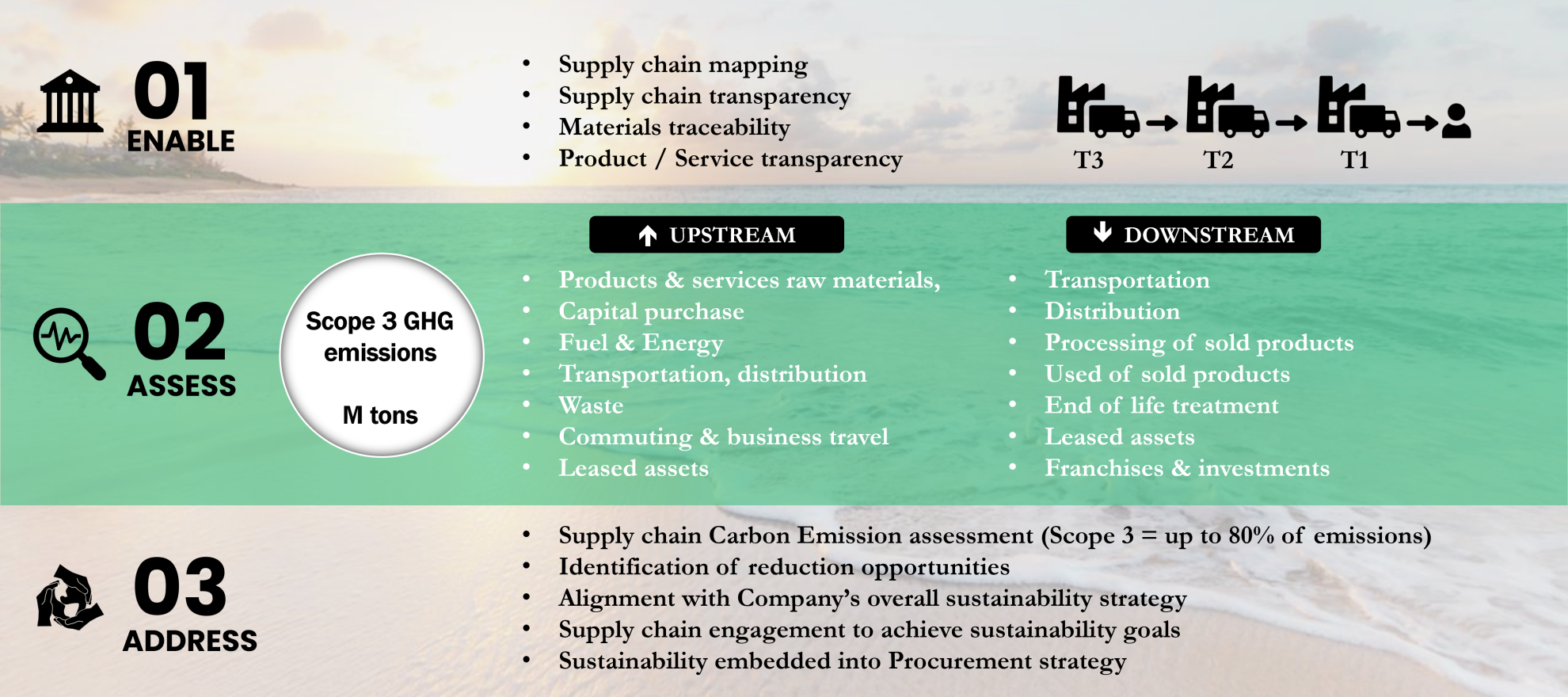
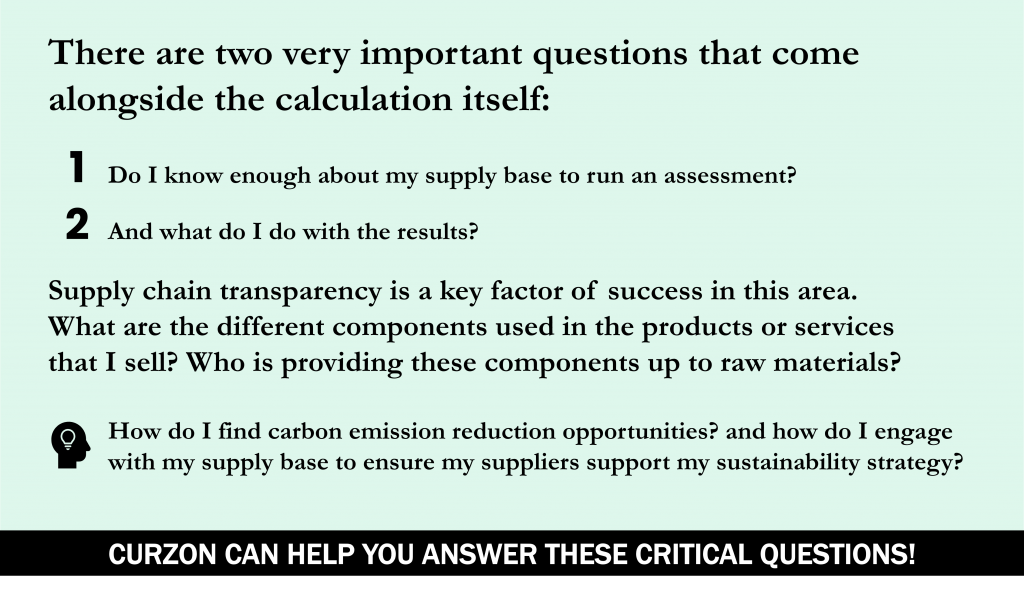
Not only we will apply our unique calculation methodology to assess the carbon emissions coming from your supply base, we will also deconstruct your product/service process to create the transparency required to run the assessment. We will then look at the results, identify opportunities, define the right strategy and engage with your supply base to ensure your goals are achieved
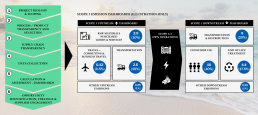
We have been helping our customers to identify and address their Scope 3 GHG emissions. Through a stepped approach, we create transparency on all procurement related Scope 3 upstream and downstream emissions
Curzon will support you on each step of the journey, from defining the scope of the project to engaging with your suppliers once opportunities have been identified
Our dashboard will bring Scope 3 emissions transparency in each component
We can also help on scope 1 & 2
With our methodology, you will be able to compare emissions generated by your supply base for each product or service that your company is selling
The illustration below, created for a healthcare institution (hospital) gives you an indication of what the outcome of our assessment could be. Please move your mouse over the picture for more information - all numbers are fictive and for illustration purpose only
(Select the image below for further detail)
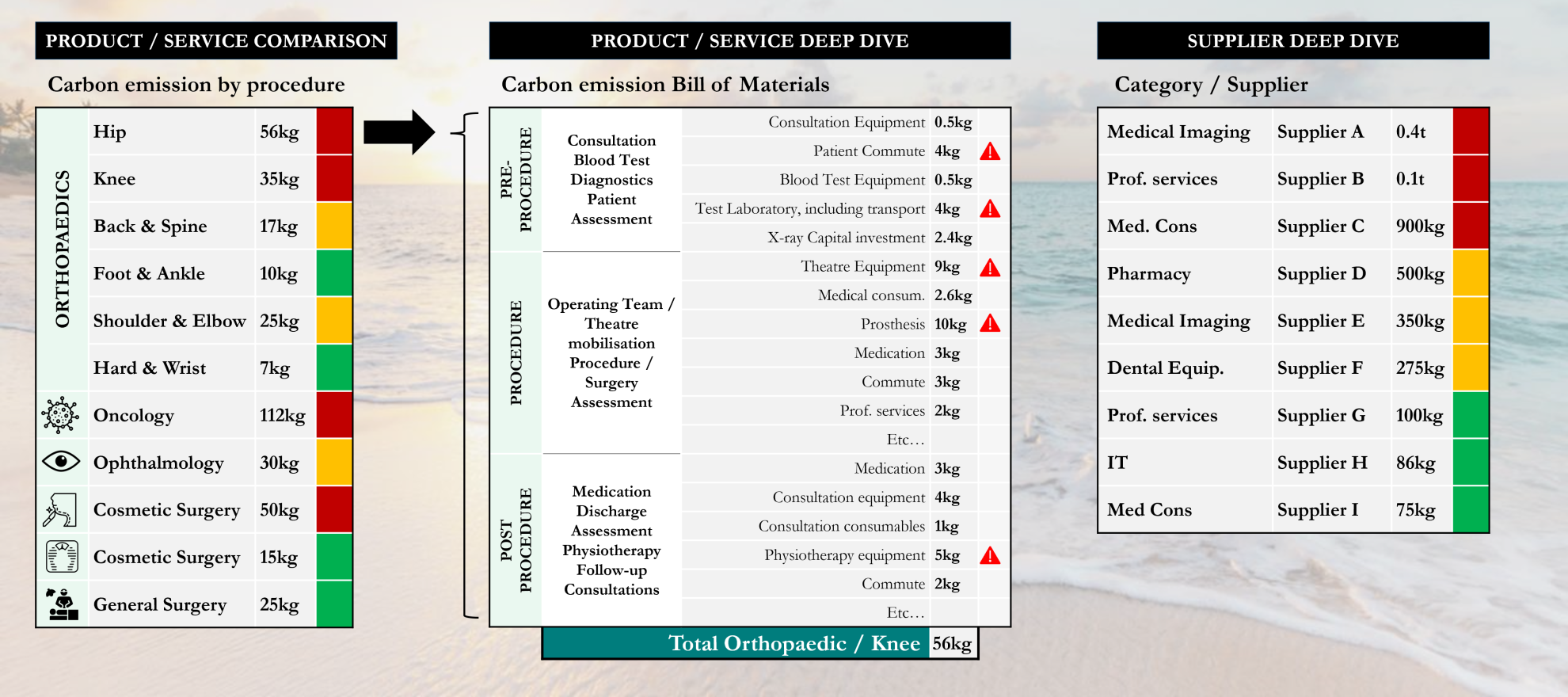
- This fictive hospital offer different type of services to its patients, from general surgery to orthopaedics, ophthalmology, etc.
- Our assessment allows this hospital to assess, for each of the service offered, the total amount of carbon emissions generated each time a procedure is conducted, for example a hip surgery generates 56kg of carbon emission (Scope 3 – supply base)
- It then allows the hospital to identify which treatment to focus on to reduce emissions and make a substantial sustainability impact, in this example hips and knees orthopaedics are highlighted in red as big contributor to the total emission
- As we identify services or products with high carbon emissions, we can then deep dive to identify where exactly in the process, emissions are the highest
- This could be a deep dive into the production process or In our example, we define the patient journey to hip surgery, from first appointment to last session of physiotherapy post operation
- Our fictive illustration shows that we need to look at patient commute, work with our lab partner our theatre equipment and the knee prosthesis to make an impact
- We also aggregate emission assessment at supplier level to identify suppliers with the highest reduction opportunities, compare similar supplier, define the reduction strategy and engage with your partner to achieve your sustainability target
The example above is just an illustration of Curzon’s expertise, applied to an healthcare example. Our expertise cover many sectors, including manufacturing
For more information on how Curzon can help your organisation in reducing Scope 3 supply base emissions, please get in touch
Want to know more?
our value proposition
Nothing found.
curzon in action
Nothing found.